

Two hours’ drive from the ski lifts of Altay, a frozen lake the size of a small sea gets cut open with saws, and a net a kilometre long drags thousands of fish out through a hole in half-metre ice. This is winter fishing at Ulungur Lake in Fuhai County, and it is the most spectacular non-ski thing you can do on a northern Xinjiang winter trip. It is also, for foreign visitors, almost completely undocumented in English. Here is how it works, when to go, and how to slot it into a ski itinerary.
Where Ulungur Lake Is and How It Freezes
Ulungur Lake lies in Fuhai County, in the Altay Prefecture of far northern Xinjiang — the same prefecture that holds the resorts most foreign skiers come for. Locals call the area the “fishing village of the northern frontier”. Fuhai sits roughly two hours by road from Altay city, which makes the lake a comfortable day trip or overnight from a ski base.
The freeze cycle is what makes the harvest possible, and it is worth understanding before you plan dates:
- November — air temperatures drop below freezing and ice begins forming at the shoreline.
- Early December — a closed fishing season begins as ice consolidates across the lake.
- December to February — sustained temperatures below −10°C push the ice out toward the centre and thicken it to roughly 50–80 cm, topped by tens of centimetres of snow.
- Mid-December to March — the prime winter fishing window, once ice will safely bear heavy machinery, horses and crowds.
- Late March to early April — the ice breaks up and the lake reopens.
That 50 cm-plus figure is not decorative. It is the safety threshold that allows winches, vehicles and hundreds of spectators onto the surface. Ice below that depth means no festival. This is also why dates move year to year and why you should never walk out onto the lake outside marked, staffed areas.
The Winter Fishing Festival: What Actually Happens
The Ulungur Lake Winter Fishing Culture and Tourism Festival began in 2004 and has run annually since, reaching its seventeenth edition by 2024 and its nineteenth by 2026. The main venue in recent years has been Fuhai County’s Sea Devil City scenic area, with the Golden Coast scenic area serving as a secondary site. Opening events have fallen in late January, with the wider fishing season extending roughly a month beyond.
The tradition itself is younger than you might assume. In 1958 Altay Prefecture assembled its first winter fishing production team, having sent people to Jilin province in the north-east to learn seine-netting under ice. Operations scaled up through the 1970s. One haul in the 1960s reportedly brought up more than 82 tonnes of fish in a single net — a figure still quoted locally.
The Waking-the-Nets Ceremony
Nets go under the ice the day before, or in the early hours of the opening day. Around midday the lake worship ceremony begins. Several dozen fishermen in sheepskin coats and fur hats, led by the yubatou or net master, kneel on one knee on the ice. They raise bowls of liquor, call out blessings, and drink. The bowls are then smashed into a pit cut for the purpose, and what remains in them is sprinkled over the nets. This is the “waking of the nets”. Lanterns, gongs and drums build the atmosphere beforehand.
Pulling the Kilometre-Long Seine
Two methods are used: gill netting and seine netting. The seine is the spectacle, and it is genuinely laborious. Crews cut a two-metre by one-metre entry hole, then chisel hundreds of smaller holes to track the net’s path beneath the ice. Ropes are anchored, a mechanical winch takes the load, and the net — around a kilometre long — is hauled in over a process lasting at least five hours.
What comes up is carp, crucian carp and Baikal roach, the small silvery fish locals call xiaobaitiao. In air that can sit at −30°C, the fish freeze within moments of surfacing, and the water on them turns to crystal beads. The first fish landed, the “head fish”, is auctioned, and the prices it fetches are a local talking point. At the seventeenth festival’s opening day, 8.1 tonnes were caught and the head fish weighed 19.9 kg.
The economics are serious rather than symbolic. Fuhai County’s winter fishing output value approached 200 million yuan in 2024, supporting processing, distribution, transport, catering and accommodation. Catches are capped and mesh sizes controlled to keep stocks sustainable.
Can Visitors Try Ice Fishing Themselves?
Yes — and this is the part most travellers get wrong, assuming it is a spectator-only event. The festival has evolved from a pure production activity into a tourism event with dedicated visitor zones. In practice you can:
- Watch the ceremony and the haul from designated safe areas as the net emerges and the fish pour onto the ice.
- Help pull the net in supervised visitor sections, under the direction of working fishermen.
- Fish a small hole yourself in the visitor ice-fishing area. Tackle can be rented on site — you do not need to bring gear.
- Ride the ice on snowmobiles, ice bicycles, skates, sleds and towed snow tubes.
Being towed on a tube behind a snowmobile across an open frozen lake is, by most accounts, the highlight for anyone who does not care about fish. Note too that local children skate the lake without skates at all — a short run-up, one foot in front of the other, and they slide. You will see it everywhere.
Eating the Catch: The Ice-Pot Fish Feast
Fish come off the ice and go straight to lakeside cooking areas. The signature dish is a large-pot fish and mutton stew, and the most memorable way to eat it is sitting at an ice table with a pot simmered in lake water. Because these are wild, cold-water fish, the flesh is firm and completely free of the muddy taste that spoils farmed freshwater fish. Clear-simmered and grilled preparations are both common. It is genuinely difficult to replicate in a city restaurant, and it belongs on any serious list of Xinjiang winter food worth travelling for.
Beyond Fishing: The Wider Winter Scene
The festival programme wraps culture around the harvest. Ice dragon boat racing is the oddity — dragon boats on a frozen surface, rarely seen anywhere. Snow horse racing draws on the same equestrian traditions found across northern Xinjiang. Folk performances, food stalls and craft sales fill out the site.
The lake itself is worth time beyond the festival. A 58-kilometre lakeside road runs along the eastern shore beside Ulungur Lake National Wetland Park, linking several scenic areas including Golden Sand Beach, which opened to visitors in 2022. In winter the appeal is the ice: a pale blue, translucent sheet running to the horizon, with meltwater audible beneath it.
Pairing Ulungur With Altay’s Ski Resorts
Fuhai sits directly on the established “Northern Xinjiang Snow Valley” winter route, which runs Urumqi – Fukang – Fuyun – Qinghe – Altay – Burqin. That corridor strings together the winter fishing festival with the region’s best skiing, which makes combining them straightforward rather than a detour.
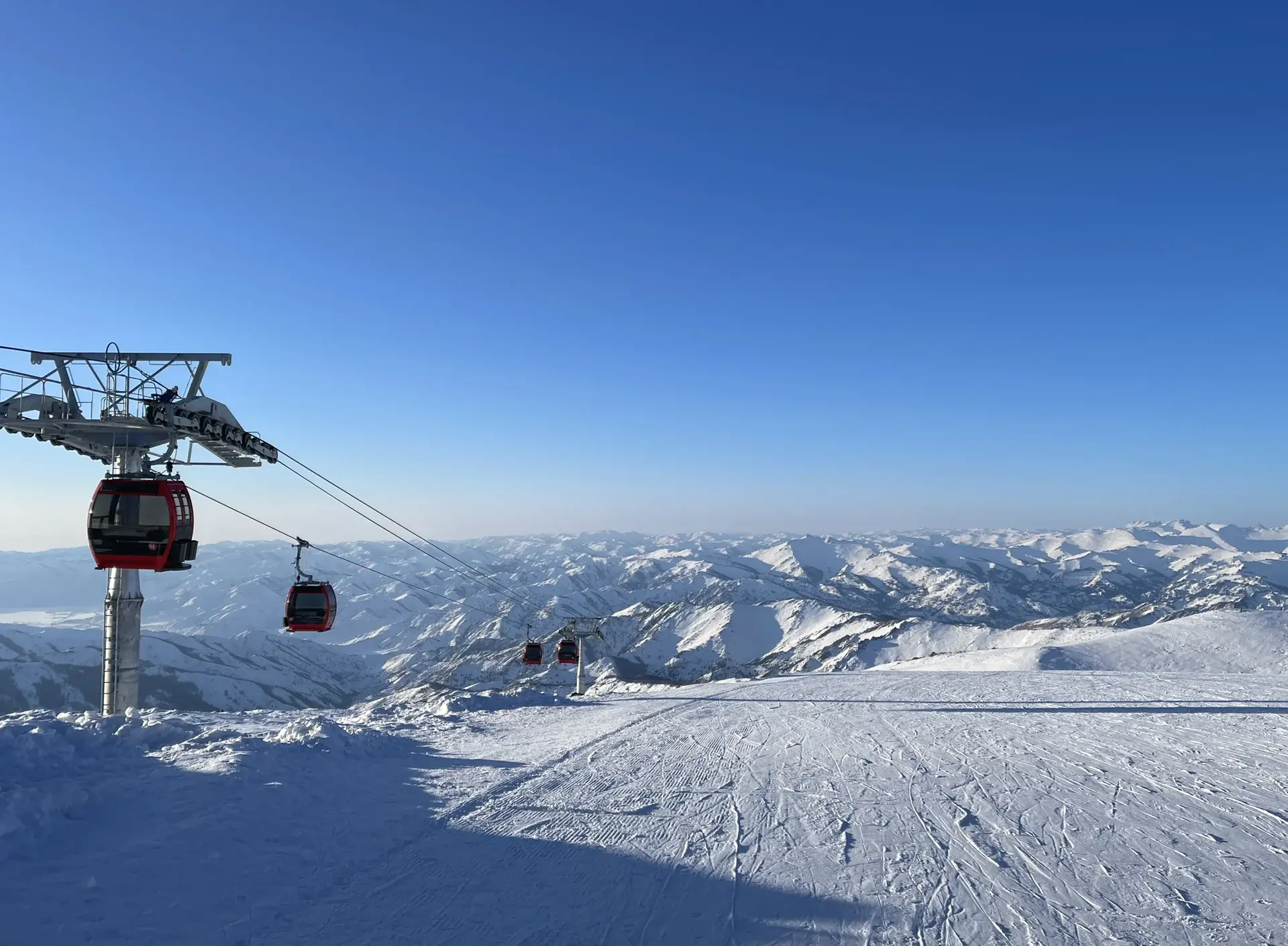
The obvious pairings on that route are Koktokay International Ski Resort in Fuyun, the powder specialist, and Jiangjunshan ski resort right above Altay city, which is the practical base for a Fuhai side trip. Further along the corridor, Kanas Lake in winter closes out the classic loop. A sensible shape is three or four days of skiing from Altay, one day out to Ulungur for the ice harvest, then onward to Kanas. Our complete Xinjiang skiing guide covers how to sequence the region.
A workable two-day version from Altay city: drive to Fuhai in the morning, visit the county museum for background on the fishing culture or head straight to Golden Coast to get oriented, overnight in Fuhai town, and be on the ice early for the ceremony. Book accommodation well ahead — festival week fills a small town fast, and the town’s bed stock is modest.
What to Wear at −30°C
This is colder than skiing, and the exposure is different. You will be standing still on open ice with wind and no shelter for hours, rather than generating heat on a descent. Ski outerwear is the right starting point, but add margin:
- Insulated boots rated well below your ski boots’ comfort range, with room for thick socks
- A windproof outer shell — wind across open ice is the real problem, not still-air temperature
- Two pairs of gloves, including thin liners so you can operate a camera without bare skin
- Full face coverage: balaclava, neck gaiter, and goggles or wraparound sunglasses against ice glare
- Chemical hand and toe warmers, and spare camera batteries kept warm inside your jacket
Most of this overlaps with a standard ski kit — see our Xinjiang ski packing list — but the standing-still factor means you should pack one layer more than you think you need.
Frequently Asked Questions
When exactly is the Ulungur Lake winter fishing festival?
There is no fixed calendar date. It depends on ice thickness and local tradition, and generally falls between mid-January and mid-February, with the opening ceremony and main events concentrated in late January. Recent editions have run two-day main programmes with fishing continuing for weeks afterward. Check Fuhai County’s official tourism announcements before booking.
Is it safe to walk on the ice?
Within the marked, staffed festival areas, yes — the ice reaches 50 cm or more before events are permitted, thick enough to carry heavy machinery. Outside those zones, do not go out. Thickness varies across a lake this size, and there is no rescue cover away from the organised site.
Can I combine winter fishing with skiing on the same trip?
Easily. Fuhai sits on the Northern Xinjiang Snow Valley route alongside Koktokay, Jiangjunshan and Kanas. Base yourself in Altay city, ski for several days, and take one day out to Fuhai, roughly two hours by road.
What fish will I actually see caught?
Mainly carp, crucian carp and Baikal roach. Head fish auctioned at the opening have weighed around 20 kg, and total opening-day hauls have reached about 8 tonnes.
Do I need to book a tour, or can I go independently?
Independent travel is possible — Fuhai is reachable by road from Altay city and the festival site is signposted and open to the public. That said, a local operator helps significantly with festival timing, transport on the day and accommodation during peak week, and gives you access to visitor fishing zones without language friction.
Is there anything to do at the lake outside festival dates?
Yes. The winter fishing season itself runs from mid-December to March, so commercial fishing continues well outside festival week. The 58-kilometre lakeside road, Ulungur Lake National Wetland Park and the blue-ice surface are accessible through the frozen months.