
If you have flown halfway around the world to ski in northern China, the last thing you want is to stand at the bottom of a lift line feeling unsure about how to get on. Riding lifts at a Xinjiang ski resort is not difficult, but the mix of equipment is broader than many visitors expect: modern detachable gondolas sit alongside older fixed-grip chairs, short beginner conveyors and the occasional surface tow. Add deep cold, thick gloves and signage that may be primarily in Chinese, and a simple task can feel intimidating on day one. This guide walks through every lift type you are likely to meet across the ski resorts of Xinjiang, how to load and unload cleanly, and the small habits that keep you comfortable when the air temperature sits well below freezing.
The lift types you will actually meet
Xinjiang’s ski areas have been built and expanded in waves, which means a single mountain can contain equipment from three different decades. Knowing the categories in advance removes most of the uncertainty.
Conveyor belts and beginner carpets
Every serious resort has at least one moving carpet on its nursery slope. You simply slide on, stand still with your skis parallel and pointing straight ahead, and step off at the top. Snowboarders keep the front foot strapped in and the back foot resting on the board. These lifts are slow by design and are where almost all first lessons happen; a fuller explanation of how the nursery areas are laid out appears in our guide to magic carpet lifts at Xinjiang resorts.
Fixed-grip chairlifts
These are the workhorses of the region. A fixed-grip chair does not slow down at the terminal, so it arrives at a constant walking-to-jogging pace. You shuffle into the loading zone, look over your shoulder, and sit as the chair reaches you. Most are double or quad chairs, many with a safety bar, and a good number have no bubble or hood, which matters a great deal in January.
Detachable chairs and gondolas
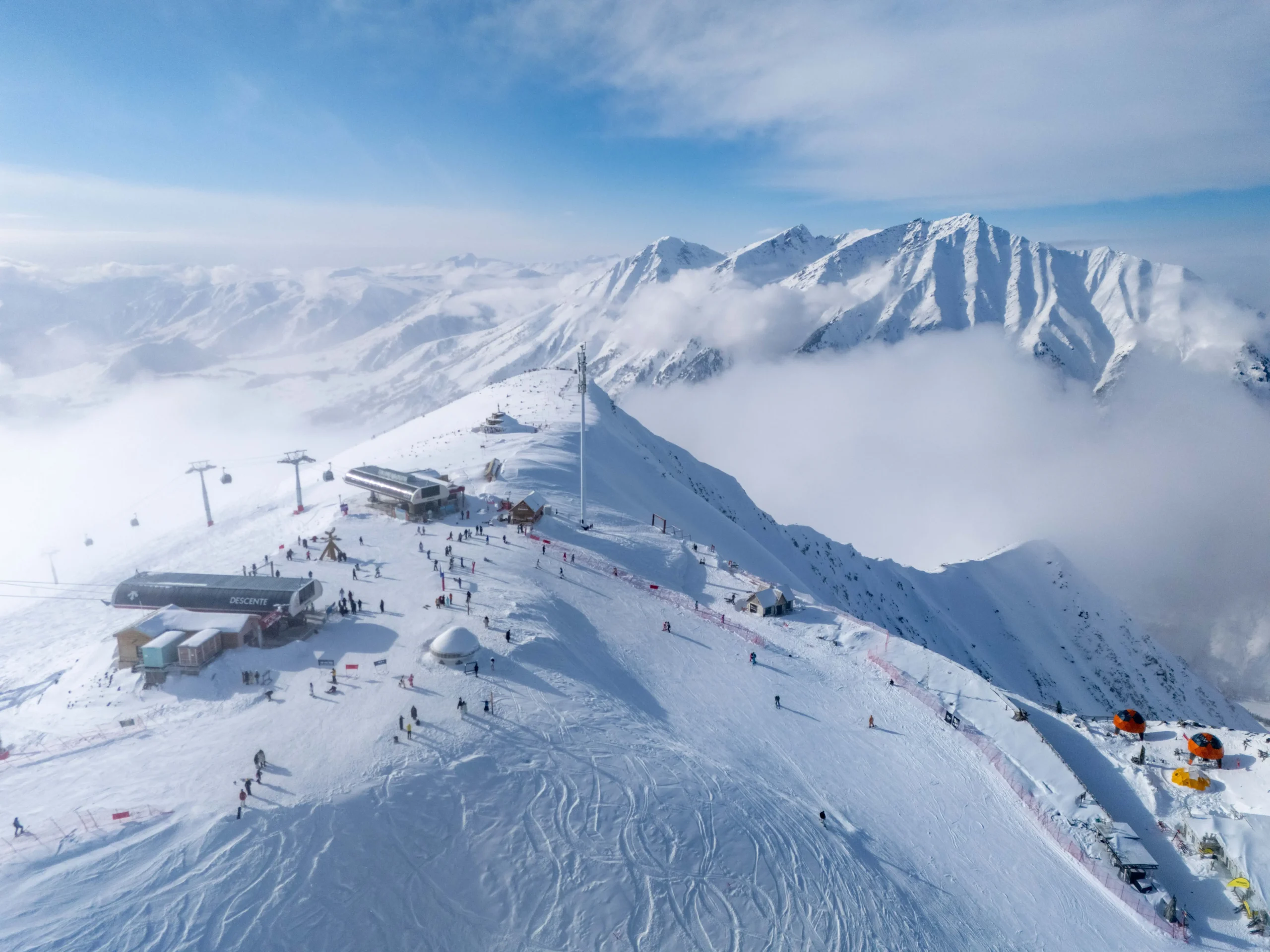
Larger areas run detachable equipment: the carrier releases from the haul rope inside the terminal, crawls slowly through the loading zone, then accelerates onto the line. These are far easier to board and are usually the fastest way to gain serious vertical. Gondolas — enclosed cabins holding six to eight people — are the most comfortable option in a cold snap because you are out of the wind entirely.
Surface lifts
T-bars, platter lifts and simple rope tows still appear on connector slopes and in older sectors. They drag you uphill across the snow rather than lifting you off it. The technique is counterintuitive at first: you do not sit down, you let the bar push you while your skis track in the pre-cut groove.
Loading a chairlift, step by step
The sequence below works on essentially every chair in the region. Rehearse it once mentally before your first ride and it will feel automatic by lunchtime.
- Join the queue in the correct lane and remove your pole straps from your wrists, holding both poles in one hand.
- When the attendant signals, slide forward to the marked waiting line — usually a painted stripe or a rubber mat — and stop with your ski tips level.
- Glance back over your outside shoulder to see the chair approaching.
- As the chair arrives, reach back with your free hand, feel the seat, and sit down deliberately. Do not jump.
- Once clear of the terminal, lower the safety bar if there is one, and rest your skis on the footrest.
- Roughly thirty metres before the top, raise the bar, point your tips forward and slightly up, and get ready to stand.
Snowboarders should keep the front foot strapped and the rear foot free, resting the board’s tail against the outside of the loading ramp so the board does not swing while sitting.
Unloading without drama
Unloading causes more anxiety than loading, largely because there is a short ramp and other people are doing it at the same time. The rule is simple: stand up, do not sit back down, and glide straight ahead until you are clear of the ramp before turning. If you fall — and plenty of people do in their first week — move sideways out of the fall line immediately rather than trying to reorganise your gear where you landed. Lift operators watch the unload ramp constantly and will slow or stop the lift if needed, so there is no need to panic.
Riding gondolas with skis and boards
Gondola procedure differs in one important way: your equipment usually travels outside the cabin. Approach the terminal, step out of your skis, and slot them into the external racks — tips up, brakes facing outward — before walking into the cabin with your poles. Snowboards go into the same racks or, at some stations, are carried inside. Remember which cabin you used and collect your gear immediately on arrival. Take the chance to drink some water and warm your fingers; a gondola ride is the best recovery time on the mountain.
Cold-weather realities on Xinjiang lifts
Northern Xinjiang gets genuinely cold, and lift rides are when you are least active and most exposed. Several practical points follow from that:
- Wind chill on an open chair can make a minus fifteen morning feel closer to minus twenty-five. A neck gaiter pulled over the nose and cheekbones is not optional.
- Mittens outperform gloves on long rides. Keep a thin liner glove underneath so you can handle a phone or lift card without exposing bare skin.
- Batteries fade fast in the cold. Keep a phone or camera in an inside pocket rather than a shell pocket.
- Goggles fog when you stop moving and clear when you ski. Resist the urge to wipe the inside of the lens with a glove — that destroys the anti-fog coating.
- Plan a warm-up stop every couple of hours. Most areas have a heated shelter or café partway up; our overview of warming huts at Xinjiang resorts explains what to expect inside them.
Lift passes, gates and card readers
Almost all lift access in the region is contactless. Your pass is a stiff plastic card with an embedded chip, and it should live in a dedicated pocket on the left side of your jacket, roughly at hip height, with no phone or metal card next to it. Walk up to the gate, wait for the beep and green light, and go. If the reader does not respond, step aside and let others through rather than repeatedly tapping. Deposits on the physical card are standard and refundable when you return it. Pricing structures, half-day options and multi-day discounts vary considerably between areas — the details are collected in our Xinjiang lift pass guide.
Queue etiquette at Chinese ski areas
Lift lines in Xinjiang are generally orderly, though the norms differ slightly from what North American or Alpine skiers may be used to. Singles lanes exist at busier resorts but are not universal, and merging tends to be handled by attendants rather than by the informal alternating system common elsewhere. A few things help enormously:
- Fill the chair. If you are a pair on a quad, wave a couple of singles over — it shortens the queue for everyone.
- Do not carry loose items in your hands. Dropped phones and water bottles are the most common reason a chair gets stopped.
- Watch out for beginners on rental gear near the loading zone; they may not be able to stop precisely yet.
- Peak periods are weekends and the Spring Festival holiday. Riding the first hour after opening buys you far more runs than any other tactic.
Reading the lift network and trail map
Trail maps are usually bilingual, but the useful information is in the symbols rather than the text. Learn to spot the lift lines and their base and summit elevations, the difficulty colours on each run, and any connector trails needed to move between sectors. Work out early which single lift serves the widest choice of terrain at your level, and treat that as your home base for the day. If you are still deciding between two disciplines and want the terrain to suit you, our comparison for first-timers choosing skis or a snowboard is worth reading before you buy a multi-day pass. Once you are comfortable riding every lift on the hill, the natural next step is exploring the forested sectors described in our guide to glade and tree skiing in Xinjiang.
If something goes wrong
Lifts stop. Usually it is for thirty seconds while an attendant helps someone load, occasionally for several minutes because of a wind hold or a mechanical check. Sitting still on an open chair in a cold wind is uncomfortable but not dangerous if you are dressed for the day: zip up fully, put your hands under your thighs or inside your jacket, and wait. Staff will communicate over loudspeakers, and evacuation procedures exist for genuine faults, though they are extremely rarely used. Dropping a ski or a pole from the chair is more common — note the nearest tower number, tell the attendant at the top, and it will be retrieved.
A short pre-ride checklist
- Pass in the left hip pocket, nothing metallic beside it.
- Pole straps off, both poles in one hand.
- Face and neck covered, goggles on, gloves cinched.
- Phone stowed and zipped, not held.
- Know which run you are taking down before you reach the top.
Frequently Asked Questions
Do lift attendants at Xinjiang ski resorts speak English?
Sometimes at the larger, more international areas, but you should not count on it. Attendants communicate almost entirely through gestures and signals, which works perfectly well for loading and unloading. Learning to recognise a wave forward and a raised hand for stop is genuinely all you need at the lift itself.
Can I stay on the chairlift and ride back down?
On most fixed-grip chairs, no — you are expected to unload at the top. Gondolas are the exception and are commonly used as download transport by non-skiing companions and by anyone who decides the run above their level. Ask at the base station whether downloading is permitted on the lift you plan to ride.
What happens if I fall while getting off the lift?
Get out of the way first, gear second. Roll or slide sideways off the unload ramp, then sort out your skis. The lift may be slowed or briefly stopped, which is routine and nothing to be embarrassed about.
Are surface lifts hard for beginners?
They take one or two attempts to learn but are not hard once the concept clicks. The key is to keep your weight centred, let the bar push you rather than sitting on it, and keep your skis in the existing track. Ask an instructor to ride one with you the first time if you are unsure.
How cold is too cold for the lifts to run?
Resorts occasionally close upper lifts for high wind rather than low temperature, and extreme cold snaps can shorten operating hours. In practice, if the mountain is open and you are properly layered with your face covered, the lifts will be running. Check the daily notice board at the base area for any wind holds before heading up.