

Accessibility information about Chinese ski resorts is scarce in English, and for Xinjiang it is nearly nonexistent — so let us be the honest source. The region’s resorts were mostly built or rebuilt after 2015, which means newer base lodges, elevators, and ramps than you might fear; but adaptive skiing programs, trained staff, and consistent barrier-free standards still lag far behind Japan, Europe, or North America. This guide covers what wheelchair users and travelers with limited mobility can realistically expect at the major Xinjiang ski resorts, where the genuine obstacles are, and how to plan a trip that works rather than one that fights you the whole way.
The Big Picture: Modern Buildings, Uneven Standards
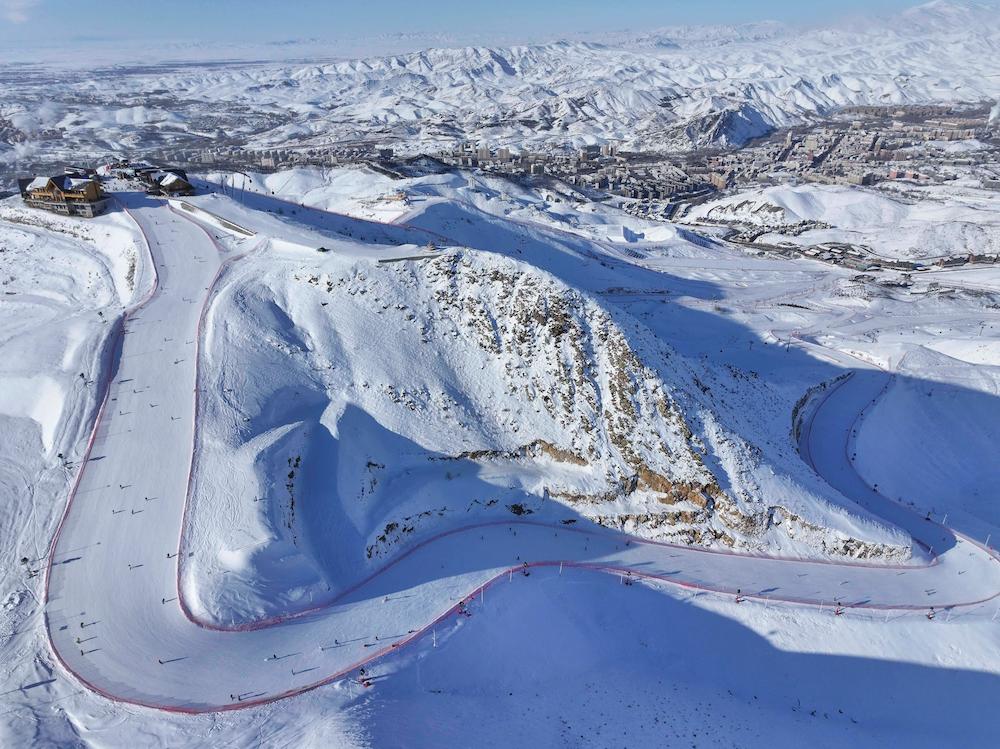
China’s national barrier-free construction codes have applied to all new public buildings since 2012, and the 2023 Barrier-Free Environment Law tightened enforcement. In practice, this means the main day lodges at Silk Road International Resort, Jiangjunshan, and General’s Mountain-affiliated facilities have step-free main entrances, elevators to upper dining floors, and at least one accessible toilet. Where the standard breaks down is everything between buildings: snow-packed plazas, high curbs at drop-off zones, temporary winter ramps made of plywood, and staff who are willing but untrained. Travel with a companion who can assist over rough ground, and most of the base-area experience is workable.
Resort-by-Resort Reality Check
Silk Road International Resort (Urumqi County)
Silk Road is the most accessible option in Xinjiang. The main gondola loads at a flat indoor station, the base hotel has an elevator and can configure a roll-in shower room with advance notice, and the drop-off loop puts you within 50 meters of the lodge doors. Sightseeing gondola rides — riding up for the view and lunch, then riding down — are the easiest way for a non-skiing wheelchair user to share the mountain day. Ask staff to slow the cabin at loading; they routinely do this for elderly visitors already.
Jiangjunshan (Altay City)
Jiangjunshan’s advantage is its location inside a real city: hospitals, pharmacies, and accessible-ish hotel stock are minutes away rather than hours. The newer base buildings have ramps and elevators, though the plaza between ticket hall and lifts is often hard-packed snow. The night-skiing operation means the lodge stays open late, which is genuinely useful for families splitting duties between skiers and a companion using a wheelchair.
Hemu, Kanas, and Village Areas
Be direct: winter Hemu is not wheelchair accessible in any meaningful sense. Wooden guesthouses have steps everywhere, paths are snow and ice, and the snow-coach transfer requires climbing aboard a high vehicle. Travelers with limited walking ability but no wheelchair do visit successfully with strong companions; full-time wheelchair users should treat it as a summer destination instead.
Is Adaptive Skiing Available?
Here is the current honest answer: there is no permanent adaptive ski program — no sit-ski fleet, no trained adaptive instructors — at any Xinjiang resort as of the 2025–26 season. China’s adaptive snow-sport infrastructure concentrated around the 2022 Paralympics in Hebei’s Chongli cluster, and some resorts there now run sit-ski sessions. If adaptive skiing is the core purpose of your China trip, Chongli is the better destination today; if Xinjiang’s scenery and powder culture are the draw, plan the trip around accessible sightseeing, gondola rides, and resort life instead. Some travelers bring their own sit-ski equipment; resorts have so far handled this case by case, so negotiate in writing through a travel agent before assuming lift access will be granted. For broader context on how instruction works for foreign visitors, our guide to ski schools for foreigners in China explains the private-lesson system that any adaptive arrangement would be built on.
Transport: The Weakest Link
- Urumqi airport: The new T4 terminal (opened 2024) meets modern accessibility standards — jet bridges, accessible toilets, wheelchair service booked through your airline. This is the smoothest part of the whole journey.
- Airport to resort: No lift-equipped accessible vans operate commercially in Xinjiang. The workaround is a standard van or SUV with a driver who assists with transfers, booked through an agent who knows the requirement in advance. A folding manual chair makes this far easier than a power chair.
- Urumqi–Altay: Fly, don’t drive. The flight is 50 minutes; airline wheelchair service works the same as on trunk routes. The 7-hour road alternative involves rest stops with poor accessibility.
- Parking: Designated accessible bays exist at Silk Road and Jiangjunshan but enforcement is loose; arriving early on weekends matters. Details on lots and drop-off logistics are in our Xinjiang ski resort parking guide.
Hotels and Barrier-Free Rooms
Every large post-2015 hotel in Urumqi has at least one nominally barrier-free room, and the Silk Road base hotel can provide shower stools and ramp access on request. In Altay City, pickings are thinner: ask specifically for ground-floor rooms with wide bathroom doors, and send a video request via WeChat so the hotel physically measures rather than guesses. Booking through a ski-specialist agent who has actually seen the rooms saves enormous frustration — a point we make repeatedly in our guide for first-time visitors to Xinjiang ski resorts.
Planning Checklist for Accessible Xinjiang Trips
- Book through an agent and state mobility requirements in the first message, in writing.
- Request airline wheelchair service at booking time for every flight segment, including Urumqi–Altay.
- Choose Silk Road as your base if step-free logistics are the priority; add Altay only with a companion.
- Carry a compact folding ramp (2–3 kg) — it solves the single-step entrances common at restaurants.
- Confirm accessible-room dimensions by video, not text descriptions.
- Schedule slack: icy surfaces slow everything, and rushing is how injuries happen.
- Winter tires on any private transfer vehicle are non-negotiable; confirm before paying.
Frequently Asked Questions
Can a wheelchair user ride the gondola at Silk Road?
Yes. The main gondola has a flat indoor loading area and staff will slow or pause cabins for boarding. A companion should assist with the transfer from chair to cabin bench; the wheelchair folds and travels in the same cabin.
Do Xinjiang resorts offer sit-skis or adaptive lessons?
No permanent programs exist as of the 2025–26 season. Travelers focused on adaptive skiing should look at the Chongli resorts near Beijing, which inherited Paralympic infrastructure and trained staff.
Are accessible toilets available on the mountain?
At the base lodges of Silk Road and Jiangjunshan, yes. Mid-mountain facilities are generally not accessible, so plan around the base area for facilities.
Is Urumqi city itself wheelchair friendly?
The newer districts, the airport, malls, and the museum area are reasonably good, with curb cuts and elevators. Older bazaar streets are harder, with steps and crowds — visit the Grand Bazaar with a companion and enter via the main plaza, which is step-free. Ride-hailing through the Didi app works well in the city, and drivers are generally happy to stow a folded manual chair in the trunk if you mention it in the pickup note.
What is the best month for an accessible Xinjiang ski trip?
Late February and March. Daytime temperatures climb toward −5°C, base plazas stay clearer of fresh ice between snowfalls, and daylight stretches past 19:30 local sun time, which gives slower-paced days more margin. January delivers the deepest powder but also the harshest cold and the iciest walkways — a tough combination when transfers already take extra time.
Does travel insurance cover disabled skiers or non-skiing disabled travelers in Xinjiang?
Standard travel policies cover non-skiing disabled travelers normally; declare pre-existing conditions honestly. If you intend to attempt any on-snow activity, confirm in writing that the policy covers it — many winter-sport clauses assume standing skiing only.