

Goggles are the piece of equipment most visitors get wrong in Xinjiang, and usually not because they bought a cheap pair. They bought one good lens and brought it to a region that produces four completely different light conditions, sometimes in the same morning. This article is narrow on purpose: it is about lens technology — what the VLT number means, which tint does what, whether photochromic lenses survive deep cold, and why fogging is a ventilation problem rather than a coating problem. Sun protection, UV ratings and skin exposure are a separate subject covered in our guide to goggles and sun protection for Xinjiang skiers. If you are still shaping the overall trip, the Xinjiang skiing guide covers the wider picture. Here we stay on the glass.
VLT: The One Number That Decides Everything
Visible Light Transmission is the percentage of light a lens lets through. It is printed on the box, it is the only spec that reliably predicts performance, and most people never look at it. Lower VLT means a darker lens. The standard bands:
- 5–15% VLT — very dark. Intense high-altitude sun on open snowfields. In Xinjiang this is genuinely useful only for a few hours around midday on the brightest bluebird days, mainly in March.
- 15–25% VLT — the workhorse sunny-day range. Handles most clear Altay days without leaving you blind when you drop into a shaded gully.
- 25–45% VLT — mixed and partly cloudy conditions. A reasonable single-lens compromise if you refuse to carry two.
- 45–70% VLT — overcast, light snowfall, late afternoon. This is the band most visitors to Xinjiang do not own and end up needing.
- 70%+ VLT — near-clear. Night skiing, heavy snowfall, dawn starts. Still worth wearing for wind and blowing snow even though it barely dims anything.
Xinjiang complicates the standard advice in two ways. The sun sits low for much of the season, so light arrives at a shallow angle and reflects off the snow into your eyes rather than down onto it — a 20% lens can feel underpowered at ten in the morning in a way it never would in the Alps. And the region produces long stretches of genuinely flat light, where a dark lens does not just feel dim, it erases the terrain.
Four Light Situations and What Each Demands
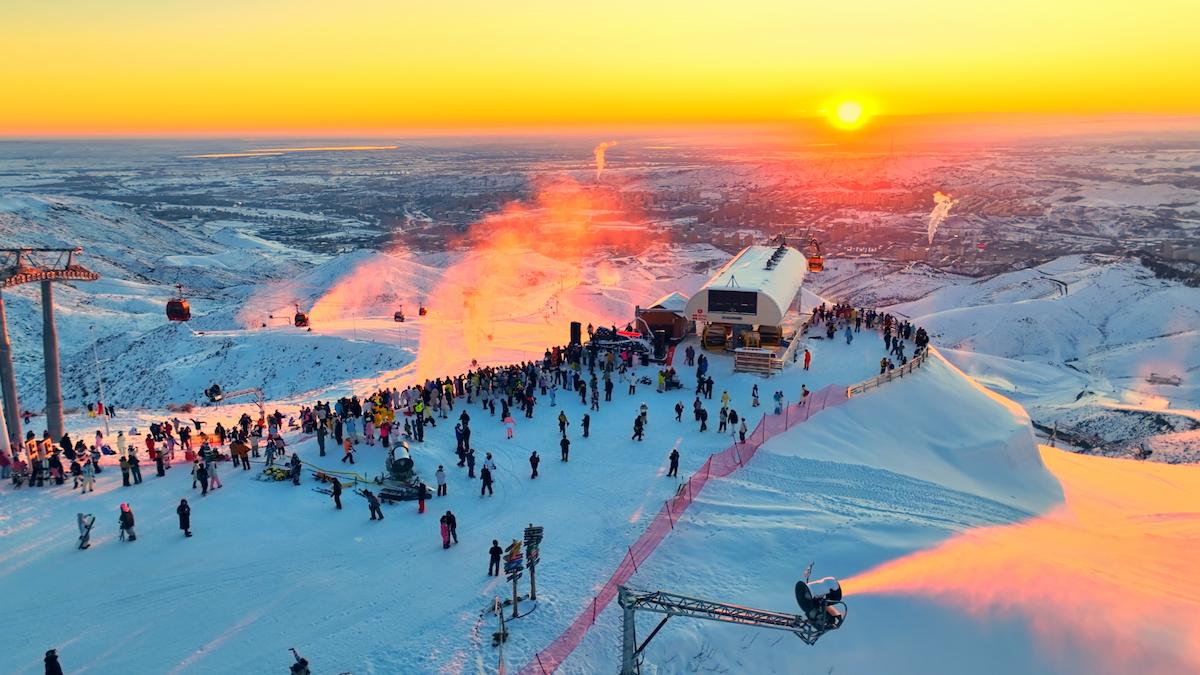
Cold Bluebird Mornings at a Low Sun Angle
Clear, minus twenty-five, and the snow is throwing light back at a glancing angle. Reflected glare dominates. Something in the 15–20% VLT range with a rose, copper or brown base handles this best. A grey lens at the same VLT will feel comfortable but flatter, which matters when you are reading a wind-scoured surface at speed.
Flat Light and Overcast Days
The condition that separates people who packed properly from people who did not. Under a uniform grey sky, shadows disappear and rollers, ruts and small drops become invisible until you are on them. You want a high-VLT lens, 50–65%, in a strong contrast tint — rose, amber or yellow. Nothing else works. A dark lens does not merely feel wrong here; it is a safety problem. Checking the forecast the night before tells you which lens to put in your pocket, and our Xinjiang ski weather and forecast guide covers how to read the regional cloud picture.
Falling Snow and Wind
Very high VLT, 60% and up, plus whatever the goggle can do mechanically to keep snow out of the vents. In heavy snowfall the limiting factor is rarely the tint — it is spindrift packing into the top foam and melting against the inner lens. Frame design matters more than optics in this condition.
Night Skiing Under Floodlights
Clear or near-clear only, 75%+ VLT. Floodlit runs produce hard pools of light and deep shadow between towers, and any tint at all will cost you detail in the dark sections. Several Xinjiang areas run evening sessions, and the lighting varies considerably between them — see the overview of Xinjiang ski resorts for which mountains operate them.
Tint and Contrast: Colour Does Different Work Than VLT
VLT sets how much light gets through. Tint decides which wavelengths get filtered, and therefore how much contrast you see. The two are independent, which is why two lenses with identical VLT can perform completely differently on the same slope.
- Rose, copper, amber, brown — cut blue wavelengths and boost the perceived contrast between snow surfaces. The most useful family in Xinjiang because they work across bright and flat conditions alike. Colours look slightly warm and wrong, which nobody notices after ten minutes.
- Grey — neutral colour reproduction, minimal contrast enhancement. Comfortable and honest in strong sun. Poor in flat light.
- Yellow and lemon — maximum contrast at high VLT, the classic snowfall and dusk lens. Can feel harsh in anything approaching bright light.
- Mirror coatings — a reflective outer layer that reduces VLT and looks good. It tells you nothing about the base tint underneath. Always check the printed VLT rather than judging by how dark the mirror appears.
The practical rule for Xinjiang: choose a contrast-enhancing base tint in both of your lenses, and let VLT do the work of matching conditions.
Photochromic and Interchangeable Systems in Deep Cold
Photochromic lenses darken and lighten automatically, and in a marketing photograph they solve this entire article. In Altay temperatures they are less convincing. The chemistry that drives the transition is temperature-sensitive and slows markedly in deep cold, so a lens that shifts in thirty seconds at five degrees can take several minutes at minus twenty-five. Most photochromic lenses also cover a limited range — perhaps 20% to 45% VLT — which is exactly the band that fails you in genuine flat light. They are a convenience upgrade for variable cloud, not a replacement for a bright-light lens or a true storm lens.
An interchangeable two-lens system is the more reliable answer, and the swap mechanism matters more than you would expect:
- Magnetic systems — swap in seconds, workable with gloves on, which is the entire point at minus twenty-five. The trade-off is a small risk of the lens detaching in a hard crash on some designs.
- Clip and tab systems — secure and cheaper, but many require bare fingers and a flexing motion. Doing that on an exposed ridge is unpleasant enough that you will simply not bother, which defeats the purpose.
- Full-frame spares — carrying a second complete goggle. Bulky, but nothing to fumble and no risk of touching the inner coating in the wind.
Fog Is a Mechanical Problem
Almost every fogging complaint in Xinjiang has a physical cause rather than a defective anti-fog coating. Warm moist air meets a lens whose outer surface is at minus twenty-five, and it condenses. The fixes are mechanical:
- Keep the double lens intact. The air gap between the two panes is the insulation. If the seal fails, moisture gets between them and no amount of wiping helps — the goggle is finished.
- Do not block the vents. Pulling a hood over the top foam or wearing a helmet that sits low against the frame cuts the airflow the design depends on.
- Route your breath away. A neck gaiter pulled up over the nose funnels warm humid air straight up the inside of the lens. A face covering with a shaped nose panel, or simply keeping the fabric below the goggle’s lower edge, solves most persistent fogging. Layering combinations that work in deep cold are covered in our Xinjiang layering guide.
- Never wipe the inside. The anti-fog treatment is a microscopically thin hydrophilic film and it comes off on the first firm wipe with a glove or a tissue. If the inner surface gets wet, shake the water out and let it air dry.
- Do not stash goggles inside your jacket. The standard instinct on a lift ride. Body heat plus sweat vapour equals a lens that fogs the moment you put it back on. Leave them on your helmet, facing forward.
Fit With Helmet and Face Coverings
A gap between the top of the goggle frame and the helmet brim lets in spindrift and cold air, and in Xinjiang conditions that means ice crystals forming on the inner foam within an hour. Test the pairing before the trip: the frame should sit flush against the helmet with no visible forehead strip, and the strap should run through the helmet clip rather than over the shell. If you wear glasses, confirm the goggle is an over-the-glasses design with side channels for the temples, because a frame pressed against the inner lens is a guaranteed fog point.
A Two-Lens Kit for a Xinjiang Week
- Primary lens, 18–25% VLT, rose or copper base. Mounted by default. Covers clear mornings through to bright afternoons.
- Storm lens, 50–65% VLT, amber or yellow. Lives in your jacket every single day. This is the lens that makes flat-light days skiable.
- A hard case with a microfibre sleeve for the spare. Loose lenses get scratched in a pack within two days.
- One clean microfibre cloth for the outer surface only, kept dry and separate from anything that has touched snow.
- A spare strap or clip if your system uses plastic tabs — cold plastic becomes brittle and tabs snap.
Skip the fifteen-lens box set. Two well-chosen lenses at opposite ends of the VLT range beat five clustered in the middle. Which one lives on your face at the start of the day depends on the season as much as the forecast — the light in December is very different from March, as set out in our guide to the best time to ski in Xinjiang.
Frequently Asked Questions
What VLT should I buy if I can only bring one lens to Xinjiang?
Around 30–40% with a rose or copper base. It is a genuine compromise — slightly bright for midday March sun and slightly dark for a full whiteout — but it is functional across the widest range. If you can carry a second lens in a pocket, do that instead; the gain is much larger than any single-lens choice.
Do photochromic goggles work at minus twenty-five degrees?
They function, but the transition slows substantially in deep cold, and most models cover only a mid-range VLT band. They handle drifting cloud reasonably and do not solve genuine flat light. Treat them as a convenience, not as a two-lens replacement.
Why do my goggles fog only on the chairlift?
Because airflow stops. Moving down a run pushes air through the vents; sitting still with warm breath rising from a neck gaiter does the opposite. Pull the gaiter below the goggle’s lower edge on the lift and keep the frame clear of your hood.
Can I clean the inside of the lens if snow gets in?
No. Wiping removes the anti-fog film permanently. Shake out the loose water, then let the goggle air dry at room temperature, face up, away from a radiator. Direct heat can warp the frame and separate the double lens.
Is a mirrored lens better for bright Xinjiang sun?
Not inherently. The mirror coating lowers VLT and reduces glare somewhat, but a non-mirrored lens with the same printed VLT performs comparably. Buy on the VLT number and the base tint; treat the mirror as cosmetic.
How many spare lenses do I actually need for a ten-day trip?
Two total — one bright, one flat-light — plus a hard case. Anything more adds weight without adding capability, since the bands in between are covered adequately by whichever of the two is closer.