

Shawan is the kind of place ski travellers drive straight past. It sits on the expressway between Urumqi and the Ili valley, and for years its role was exactly that — a fuel stop with unusually good chicken. That has changed. A new snow park at Lujiaowan, a hot spring valley upgraded to autonomous-region resort status, and a winter carnival that now runs from December into March have turned Shawan into a legitimate two-day stop rather than a lunch break.
One thing to be clear about from the start: Lujiaowan is a snow-play and hot spring destination, not a lift-served ski resort. If you want vertical, you pair Shawan with proper resorts elsewhere. If you want a recovery day, folk culture and a soak in mineral water at 53 degrees, this is one of the best-value stops in northern Xinjiang.
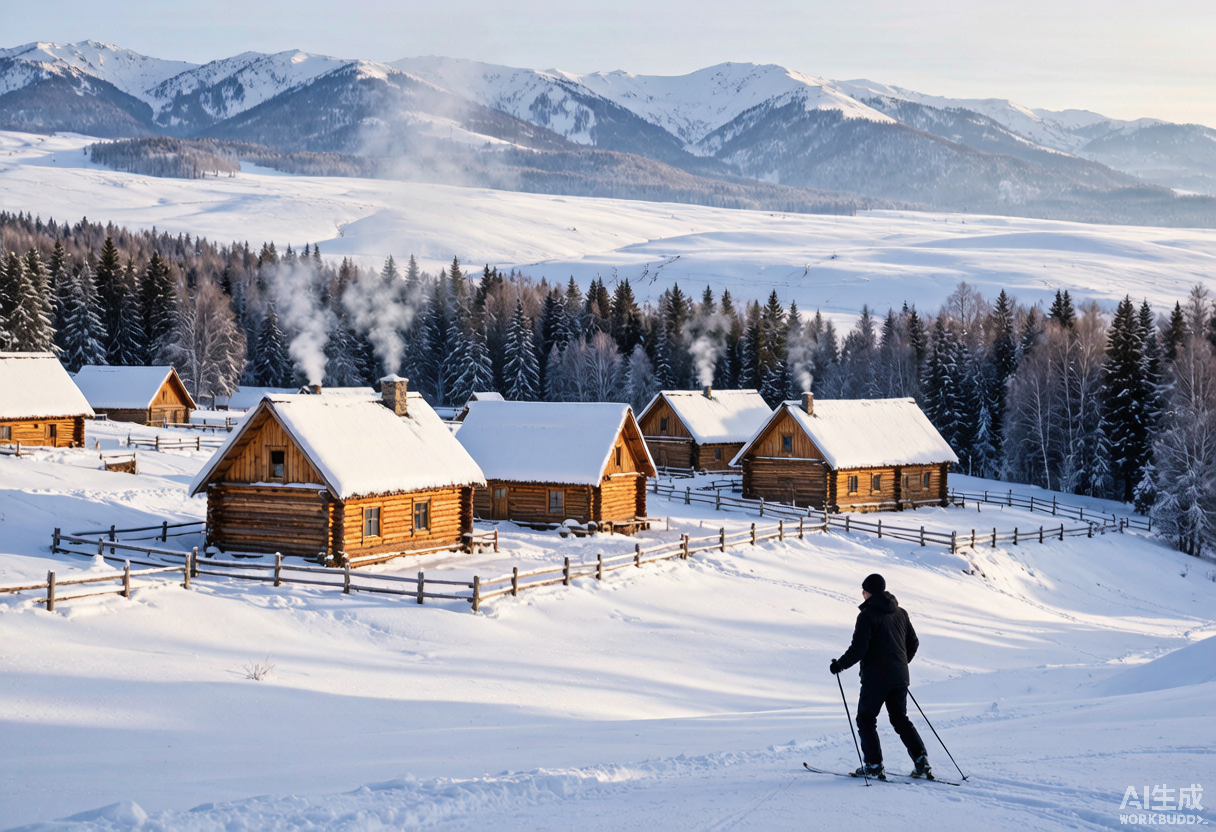
Where Shawan Is and How It Fits a Ski Trip
Shawan City belongs to Tacheng Prefecture and sits in the core of the northern Tianshan economic belt, roughly 185 kilometres from Urumqi. The G30 Lianhuo Expressway and the G312 national highway both run through it, and within about 550 kilometres you can reach four first-class land ports — Khorgos, Alashankou, Baktu and Jeminay. In practical terms, it is an easy half-day drive from the capital and a natural break on any route heading west.
That position is the whole argument for including it. Fly into Urumqi, ski the resorts near the capital, then break the westward drive here before continuing into Tacheng Prefecture or Ili. Our Xinjiang ski transport guide covers the road and rail links in more detail.
Lujiaowan: A 400-Mu Snow Park in a Deer Valley
Lujiaowan — Deer Antler Bay — lies southwest of the city at the foot of the Tianshan, in Bortonggu Township along Provincial Road 101. The scenic area covers more than 19,000 hectares and combines snow peaks and glaciers, high-altitude spruce and pine forest, and alpine grassland. The name comes from Tianshan red deer, which once bred here in numbers and shed antlers into the ravines each year.
For the 2025-26 season the headline addition was an immersive ice-and-snow park of roughly 400 mu (about 27 hectares). It is built around participation rather than spectating:
- Snowmobile runs through open snowfield and forest edge.
- Horse-drawn sleighs, the standard northern Xinjiang winter ride.
- Skating and snow tubing areas suitable for families.
- Themed homestays inside the scenic area, marketed on stargazing after the day visitors leave.
The park’s opening weekend gives a sense of the scale of demand. Over the three-day New Year holiday in 2026 the operators ran twelve themed livestreams that drew more than 500,000 online viewers, the park itself received about 32,000 visitors, and direct revenue passed eight million yuan. Scenic area admission was waived for the holiday. Expect crowds on public holidays and near-solitude midweek.
Shawan Hot Springs: The Real Reason to Stay the Night
Six kilometres of winding road above the grassland, the Jingou River valley holds the springs that made Shawan a wellness destination. Water emerges from limestone fissures at 53 degrees Celsius, with a daily flow of more than 3,000 cubic metres and over thirty dissolved minerals including hydrogen sulphide and metasilicic acid. In 2024 the Shawan Hot Spring Tourism Resort was designated an autonomous-region-level tourist resort.
The flagship property, opened in 2019, keeps its outdoor pools inside native forest: mature trees left in place, cobblestone paths following the slope, and 24 open-air pools among roughly 35 in total, fed by water piped in sealed lines from a source seven kilometres away and then temperature-graded for indoor and outdoor use. Management reports winter reception rising year on year, and a second phase under construction will add around 200 rooms.
For skiers, the appeal is straightforward: hot mineral water is one of the few genuinely effective ways to reset your legs mid-trip. Our guide to hot springs for ski recovery in Xinjiang explains how to time a soak so it helps rather than flattens you.
Where to Actually Ski Near Shawan
Shawan itself does not offer lift-served alpine terrain, so build the skiing around it:
- East, towards the capital. The resorts clustered near Urumqi are about 185 kilometres away — comfortably reachable, and covered in our Urumqi ski resorts overview.
- West and north, into Tacheng Prefecture. Shawan’s own prefecture runs a substantial set of ski areas and outdoor ice rinks; see the Tacheng ski resorts guide for the breakdown, including the night-skiing runs and snow hotpot at Emin’s resort.
- Northwest, to the oil cities. Karamay’s resorts make another logical leg of the same loop, detailed in our Karamay ski resorts guide.
Nearby Wusu has also opened a snow park combining ice, hot springs and folk performance, and Emin’s resort added night runs for the 2025-26 season — useful backups if weather closes one option.
The Winter Events Calendar
Shawan’s ice and snow carnival launched in December 2025 and runs through March 2026, with a parallel hot spring wellness programme bundling admission and accommodation and adding sauna and therapeutic dining services. The New Year programme at Lujiaowan is the noisiest weekend of the season: drum performances and dombra music, kokpar, the girl-chase game, silver-picking from horseback, a sheep-butchering demonstration, snow football and snow treasure hunts.
The prefecture-wide numbers show why local governments keep funding this. Over the three-day 2026 New Year holiday, Tacheng Prefecture received 208,600 visitors and 135 million yuan in tourism spending, up 12.4 and 13.6 percent year on year; Shawan’s own holiday tourism revenue reached 26.36 million yuan, up 28.93 percent. Supporting measures included ticket waivers, consumption vouchers, low-interest loans for tourism businesses and free skiing for young people.
Food: This Is the Home of Big Plate Chicken
Shawan’s genuine claim to fame is culinary. Big plate chicken — dapanji, chicken braised with potato and chilli and served over wide belt noodles — is associated with this city, and eating it here is not a tourist trap but the point of the visit. At the snow park food area, prices stay low: minced-meat pilaf has been sold at 9.9 yuan, alongside grilled skewers, thin-skinned dumplings, offal soup and morel-and-chicken broth. A group ordering the hotpot version of big plate chicken is the standard winter table.
Local produce stalls at events sell corn, black wheat flour and dried milk curd from surrounding villages. For a wider view of what to eat on a Xinjiang ski trip, including halal considerations, see our Xinjiang ski food guide.
Practical Planning Notes
- Getting around: a car is close to essential, since the snow park and the hot spring valley are separate mountain destinations. Winter tyres, not all-season.
- Capacity: guesthouses inside Lujiaowan are small — one long-running operator has about fifty beds — so book ahead for holidays.
- Momentum: in the first half of 2026 Shawan received 3.14 million visitors, up 3.86 percent, with tourism revenue of 2.2 billion yuan. Facilities are improving quickly, which also means published details date quickly.
- Timing: late December to late February is reliable for snow cover; the hot springs work all winter.
- Costs: this is a cheap stop by Xinjiang standards, especially outside the New Year weekend when admission promotions appear.
A Two-Day Shawan Plan
- Day 1: Drive from Urumqi in the morning, lunch on big plate chicken in town, afternoon at the Lujiaowan snow park for snowmobiles and a sleigh ride, then check into a scenic-area homestay for the stars.
- Day 2: Slow morning in the forest, then the Jingou River valley for several hours in the open-air pools, and back on the expressway by evening — or continue west into Tacheng Prefecture for the next ski leg.
Frequently Asked Questions
Can I ski at Lujiaowan?
Not in the alpine, lift-served sense. Lujiaowan’s winter offer is a snow park — snowmobiles, sleighs, skating and tubing. For chairlifts and graded runs, use the resorts near Urumqi or elsewhere in Tacheng Prefecture.
How hot are the Shawan hot springs, and are they open in winter?
The source water emerges at about 53 degrees Celsius and is temperature-graded across roughly 35 pools, 24 of them outdoors. Winter is the busiest season, and soaking outdoors while snow sits on the surrounding trees is the main attraction.
How long does the drive from Urumqi take?
Shawan is roughly 185 kilometres from Urumqi on the G30 expressway, so a straightforward half-day in good conditions. Add a substantial buffer during snowfall, when expressway sections can close.
Is Shawan suitable for families?
Yes, unusually so. Snow tubing, skating, sleigh rides and shallow warm pools work well for children, and the snow park was designed around family participation rather than technical sport.
When is the best time to visit?
Between late December and late February for dependable snow. Avoid the New Year holiday itself unless you want the folk-sports programme, since visitor numbers spike sharply for those three days.