

Short answer: APEC Shenzhen 2026 falls in November, when the northern ski season is only just waking up in Xinjiang and the Pearl River Delta stays warm. For a skier, Shenzhen is not a snow destination; it works as a warm-weather city add-on before or after a northern trip, not a substitute for the mountain.
By Karl Huang · Updated 20 November 2026
On paper, a skier has no business in Shenzhen in November. The season I care about is only just waking up in Xinjiang, while the Pearl River Delta stays warm enough for short sleeves. I had spent three winters chasing first snow in Altay, and every November the same argument: stay for the mountain, or fly south? APEC Shenzhen 2026 settled it. It gave me a reason to test Shenzhen winter travel against the snow calendar I live by, and the comparison was more interesting than either choice alone.
I arrived skeptical and left convinced a southern city has a real place in a winter itinerary, as the other half of a season stretching from freezing north to subtropical coast. Time-sensitive facts here are dated as of 20 November 2026; confirm with official sources before booking.
- Host city: Shenzhen. The 33rd APEC Economic Leaders’ Meeting is China’s third time hosting, after Shanghai 2001 and Beijing 2014. (As of 20 November 2026; confirm with official sources.)
- Leaders’ Meeting: 19 November 2026; Economic Leaders’ Week began 14 November. (Confirm with official sources.)
- APEC CEO Summit: 18 November 2026; it issued the “2026 APEC CEO Summit Shenzhen Initiative.” (Confirm with official sources.)
- Theme: “Building an Asia-Pacific Community to Prosper Together,” with priorities of openness, innovation and cooperation.
- 21 member economies; the APEC Business Travel Card covers all 21, with over 460,000 holders.
- Xi Jinping announced US$20 million for practical cooperation and a planned Asia-Pacific Community Research Centre in Shenzhen. (Confirm with official sources.)
- Best window: October to December. Shenzhen has no outdoor natural snow, only indoor ski resorts. The city is cashless: set up Alipay or WeChat Pay before arrival.
Why Shenzhen winter travel works for a skier in November
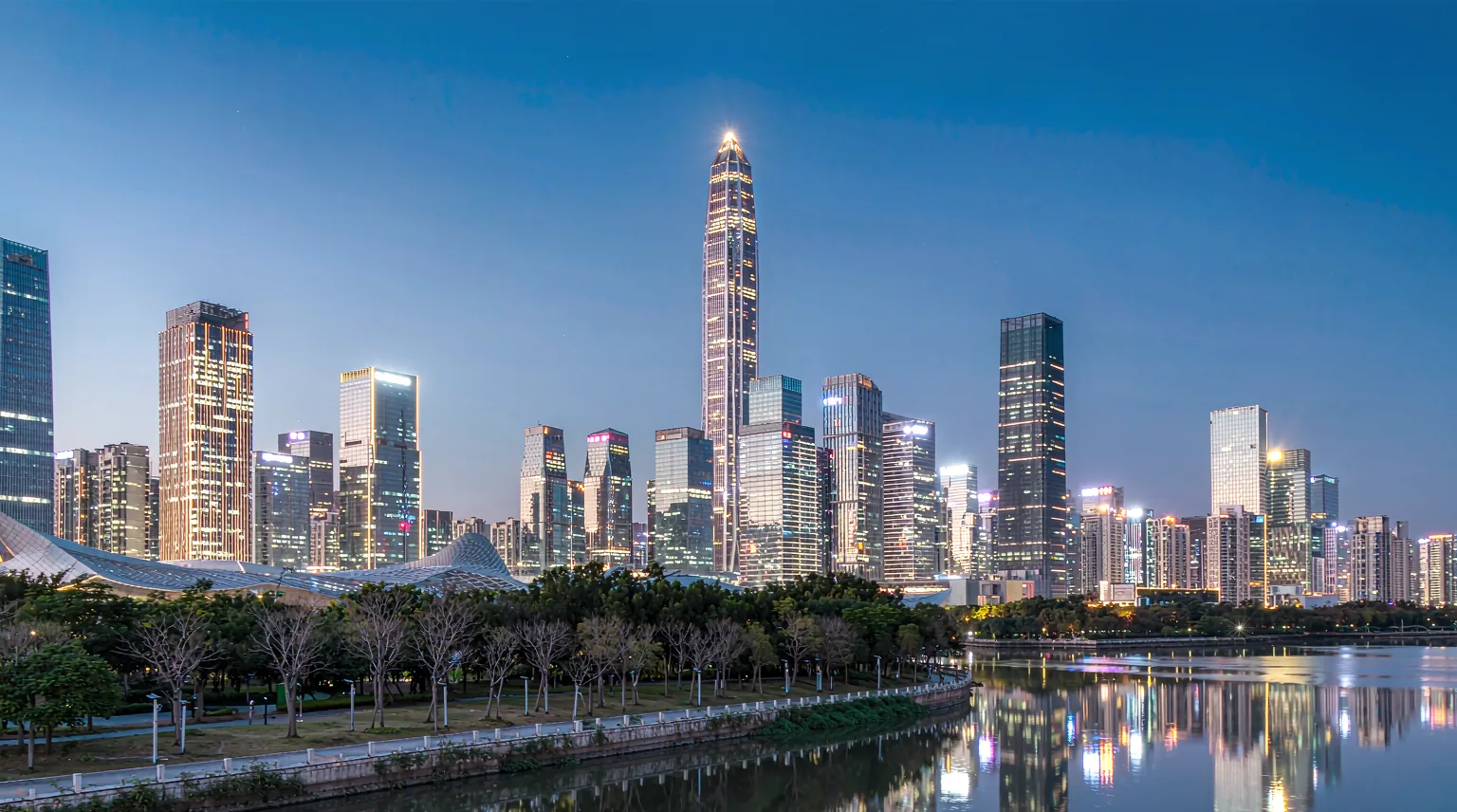
Every northern skier knows the problem. Snow arrives late, flights cost a fortune, and the body has not adjusted to cold. In Xinjiang the season builds through November, but early on the reliable terrain is still finding its feet. Shenzhen offers the opposite: daytime warmth, a coastline, a skyline that lights up after dark, and a summit pulling leaders into town in the same window.
The logic hit me on my second morning. I expected a city that would bore a snow person and instead found a place where the November climate is the point. You can walk outside without a jacket, eat at an outdoor table, and still finish the day in a refrigerated ski dome. That is what makes Shenzhen winter travel worth understanding: it is not the mountain, it is the rest of the winter. Skiers spend so much time optimizing snow days that we forget the shoulder weeks can be spent somewhere warm.
APEC gave the argument a deadline, folding a global event into an already pleasant window, and the city visibly prepared. Used to quiet mountain towns, I found the contrast to be the story. In my notebook I listed things impossible on a ski trip: a laser show on towers, a water-screen projection on the Houhai skyline, dim sum in shirt sleeves on 20 November. None replaces a powder day, but all of it makes the weeks around one more bearable.
The snow calendar: Xinjiang winter versus a warm Shenzhen November
The fastest way to explain the choice is a direct comparison. Ski-season timing is a general pattern, not a guarantee, so check resort reports. For a regional breakdown see how China’s snow season varies by region, and for timing when the ski season starts in China.
| Factor | Xinjiang (Altay / Ürümqi) | Shenzhen in November |
|---|---|---|
| November feel | Cold, settling snow, season building | Warm days, light evenings, short sleeves |
| Outdoor natural skiing | Yes, the country’s core snow region | None — indoor ski resorts only |
| Daylight | Short, cold, mountain-focused | Long enough for beaches and parks |
| Evening scene | Quiet resort nights | 43-tower light show, water screens, rooftop bars |
| November 2026 event | Early-season training | APEC Leaders’ Week, 14–19 November |
| Best window | December to February | October to December |
The table hides how well the halves fit. A November trip to Shenzhen costs little in snow terms because the best Xinjiang weeks come later. Fly south in the third week of November, then head north once the base depth is right. At the airport I noticed others making the same calculation: ski bags one way, light carry-ons the other.
Can you actually ski indoors in Shenzhen?
This is the first question I ask anywhere warm, and the honest answer is that Shenzhen has no outdoor natural snow. Anyone who says otherwise is confusing it with northern resorts. What it has is indoor skiing, enough to keep a feel for snow between trips. I spent an afternoon on a slope at the city edge and the sensation was exactly what I needed: cold air, a groomed surface, the rhythm of turns. It is not the mountain, but in November that matters less.
Indoor facilities here serve a local population that rarely sees real snow, so the atmosphere differs from a Xinjiang lift line. First-timers, families and a few serious riders share the same run, and I found the mix refreshing. My guide to China’s indoor ski resorts covers the larger domes, while a shorter piece on indoor skiing in China explains what to expect from the snow and gear. Neither claims Shenzhen has replaced the north; they tell you where to scratch the itch.
For anyone planning a full winter, I would point to ski resorts across China, because the indoor day makes more sense within a wider itinerary. My rule: one session keeps the muscles honest, but I would never fly this far south just for that. The slope was a side note in a full week; I came out with the odd satisfaction of having skied where it was above twenty degrees.
APEC Shenzhen 2026: what the meeting meant on the ground
A summit changes a city in ways a visitor can read on the street. The Leaders’ Meeting was on 19 November 2026, Economic Leaders’ Week began on 14 November, and the CEO Summit took place on 18 November, issuing the “2026 APEC CEO Summit Shenzhen Initiative.” The theme was “Building an Asia-Pacific Community to Prosper Together,” built on openness, innovation and cooperation. These dates are as of 20 November 2026; confirm with official sources. The APEC Secretariat’s news release verifies the sequence.
There is substance under the slogans. Xi Jinping set out four pillars: economic and trade cooperation, connectivity, innovation and development. He announced US$20 million for practical cooperation, a planned Asia-Pacific Community Research Centre in Shenzhen, and new institutions for digital technology, cross-border data flows, clean energy and small businesses. He invoked a giant peng bird spreading its wings, a nod to Shenzhen’s nickname “Pengcheng,” or Roc City. The Xinhua record of the speech carries the wording; confirm with official sources.
The Shenzhen Initiative covers livelihoods, food trade, cross-border QR-payment interoperability, cutting non-tariff barriers, a green trade rules framework and AI for public good. Leaders from Russia, Vietnam, Malaysia, South Korea, Thailand, Canada and Australia spoke, per Xinhua’s CEO Summit report. Two numbers connect to travel: the Business Travel Card has over 460,000 holders across all 21 economies, and regional GDP growth is projected at 3.4 percent for 2026, up from 3.2 percent in 2025. Rail connectivity rose about nine percent from 2015 to 2025. Verify such figures before formal use; as of 20 November 2026 they come from APEC sources.
Pansy Ho discussed “multi-stop” travel and two-way visitor flows in the Greater Bay Area, and China UnionPay described interoperable QR payments with Indonesia, Vietnam and Singapore. The summit was describing the itinerary I was living: ski region north, warm city south.
Light, water and skyline: the city after the sessions
The clearest change was the lighting. Civic Center Square ran a special four-night schedule from 12 November 2026, with 43 skyscrapers synchronized across a 270-degree panorama at 19:00, 20:00 and 21:00. The regular November-to-March schedule is those hours on Fridays, Saturdays and holidays, booked via WeChat mini-program. Schedules can shift during APEC, so confirm with official sources. I stood there on a mild evening with office workers eating takeaway and watched the towers move. It was the first thing that made me forget I was a skier.
Civic Center Square is on Metro Lines 2 and 4, Civic Center Station Exit A or F; Talent Park is on Line 13, Exit B1. The city’s English-language APEC page has visitor details; confirm timings there.
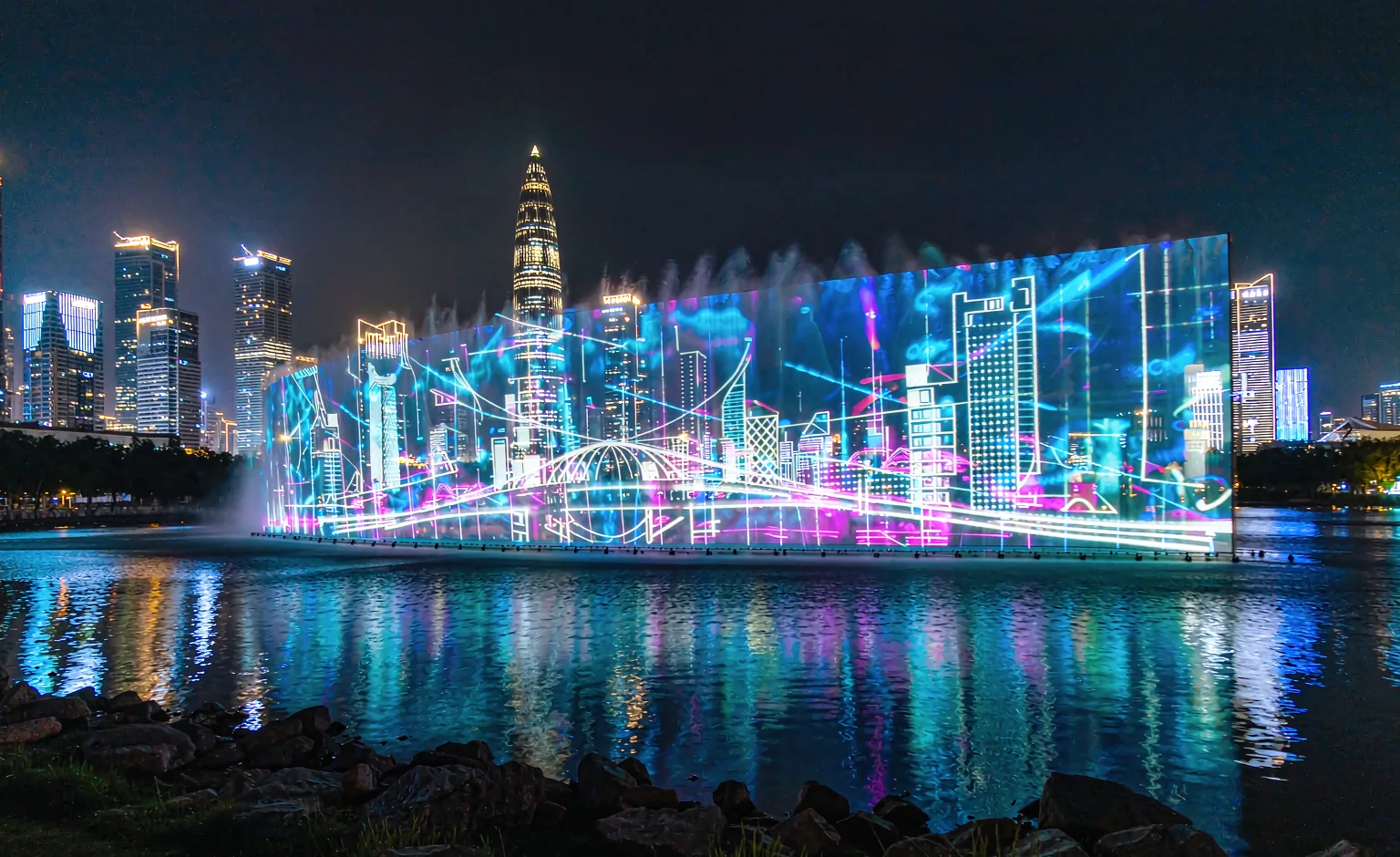
Talent Park was my favorite. Its water-screen show uses jets, lasers and landmark projections against the Houhai skyline, including the China Resources Headquarters Tower, or “Spring Bamboo.” I walked out on Line 13 after dinner on a whim, found a place on the grass and stayed for the whole sequence. Water, light and warm air felt designed for someone who spends winters bracing against wind. Above it is the Ping An Finance Centre, fourth-tallest in the world, with an observation deck around 562 metres and a ticket near ¥200. I went up on the last afternoon and saw the delta hazy in late light. Prices and hours change, so confirm with official sources.
Between the sessions: places I actually went
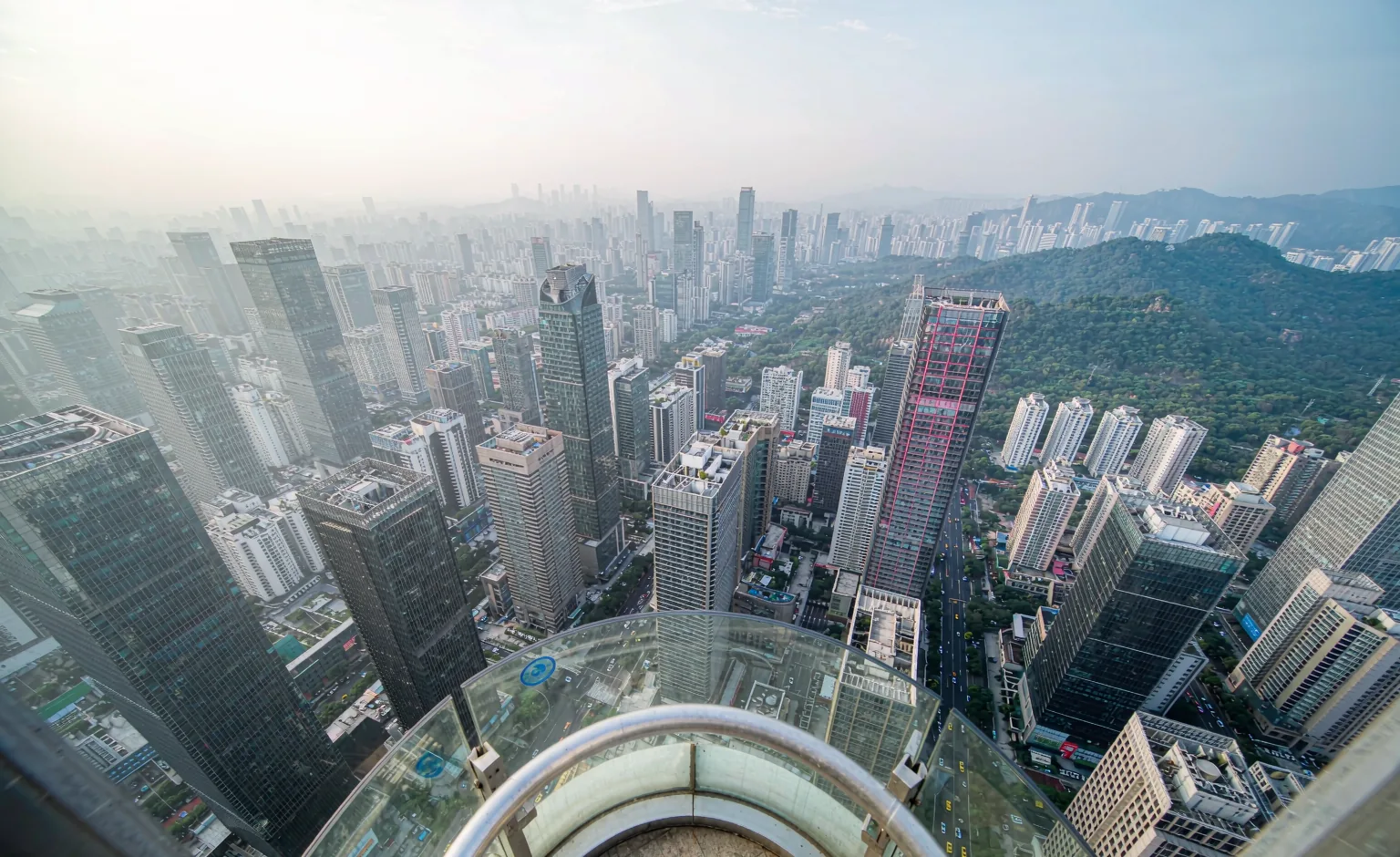
A summit week leaves gaps, which I filled with the ordinary city rather than a checklist. The best skyline view is free. Lianhua Hill Park has a short paved walk to the Deng Xiaoping statue, and going before sunset lays the city out in soft light. I made that walk twice. It is the one place a mountain person feels at home, with a real incline even if the summit is a city terrace.
Parks, art and a theme park
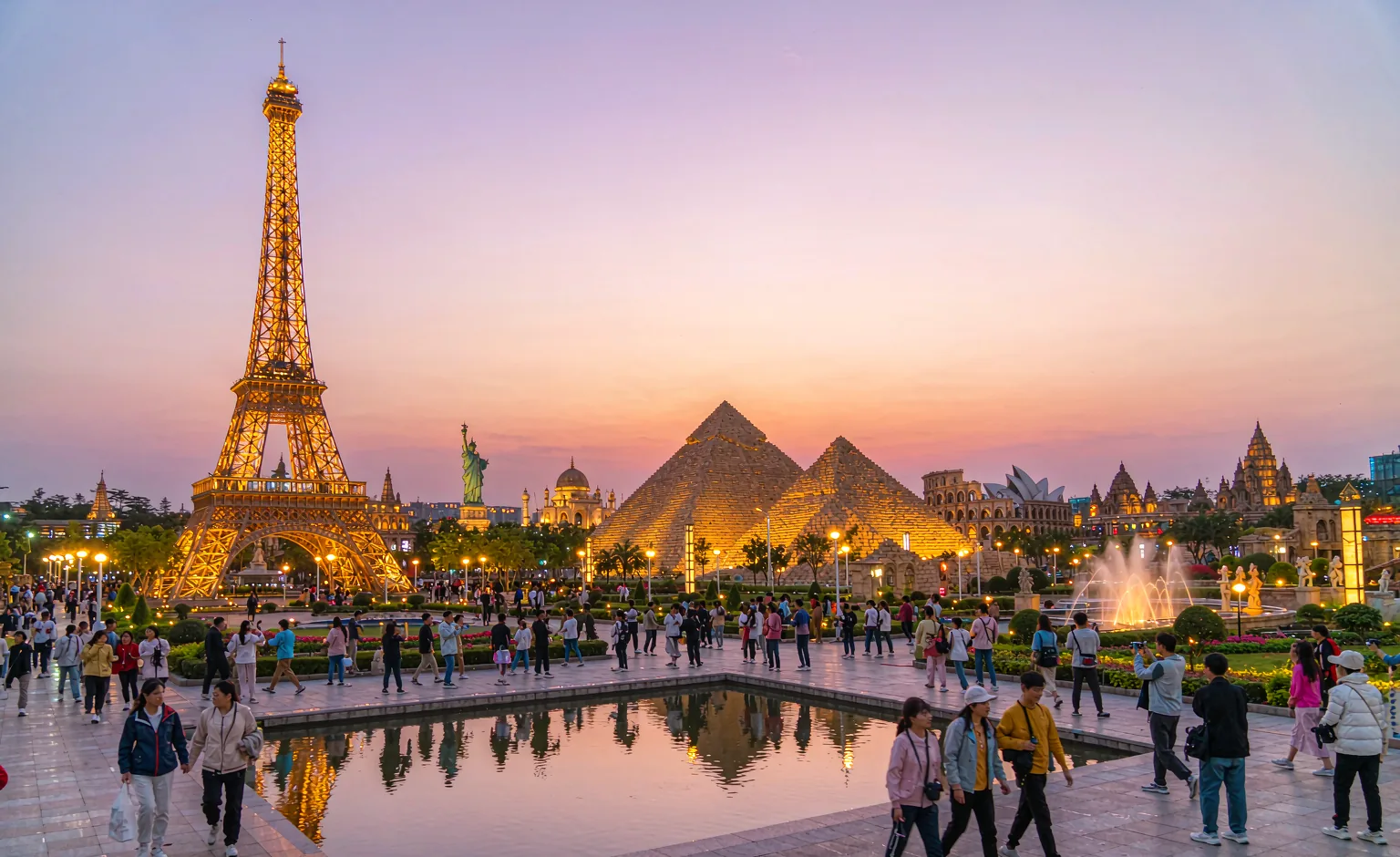
Window of the World is a miniature-landmarks theme park, roughly ¥120 and about half a day. I expected kitsch and stayed longer than planned, because watching visitors move between tiny famous places is its own theater. Splendid China Folk Village covers the country’s ethnic regions and architecture in one park, which I skipped. OCT-LOFT Creative Culture Park was the surprise: a former industrial estate turned arts district with galleries, independent cafes, jazz bars and street art, and no entry fee. I spent a slow afternoon nursing a coffee. The Shenzhen Museum, Dafen Oil Painting Village and Huaqiangbei electronics market are easy additions.
The coast, and a beach in November
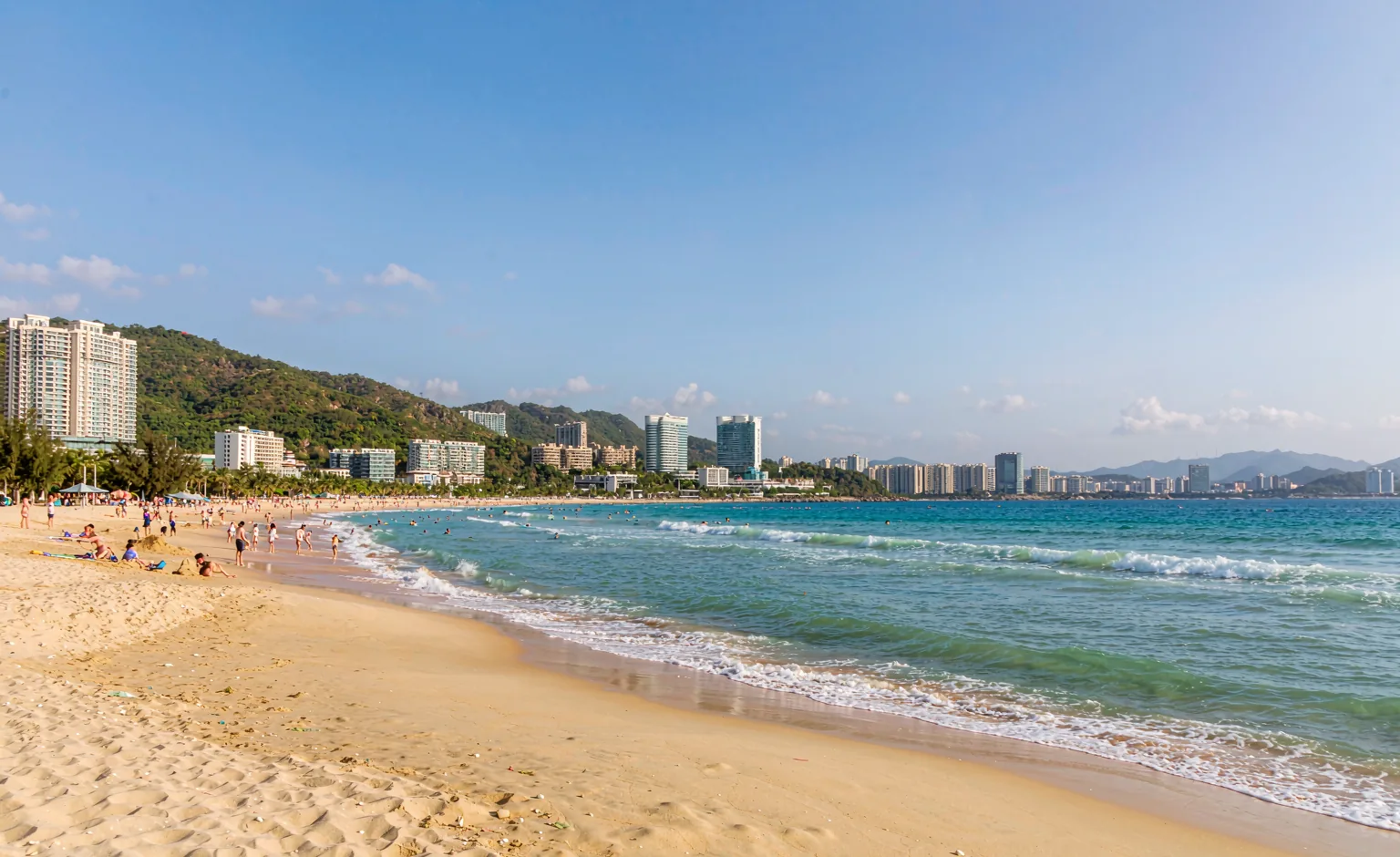
Dameisha Beach is the nearest sand and busy on weekends. I went on a weekday and found a quiet stretch where families flew kites in the warm wind. Swimming in November is optimistic; I walked the promenade. Shekou’s “Sea World” is a waterfront plaza rather than an aquarium, with the Minghua ship, a fountain show and international restaurants. Dapeng Fortress, a Ming-dynasty fort near Jiaochangwei beach, needs a full day.
What I ate between meetings
The food is Cantonese at base and national in range. Dim sum is the starting point: har gow (虾饺), siu mai (烧卖) and char siu bao (叉烧包), taken slowly over tea. A roast goose dinner justified the flight on its own. Nanshan is known for coconut chicken, Luohu for claypot rice, and Leyuan Road and Shekou for South China Sea seafood. “Urban villages” such as Baishizhou hold the budget eats. I finished most nights at a Futian rooftop bar with the towers lit below, a habit I would never pick up in a ski resort.
Practical notes from a winter traveler
Shenzhen runs on phones. Set up Alipay or WeChat Pay with an international card before landing, as almost nothing takes cash. The metro is clean and extensive, and an eSIM keeps navigation working. English is spoken in high-end hotels and by younger tech workers. Tipping is not expected. I heeded warnings about tea-house and student-art scams in Luohu. Luohu suits budget stays and the Hong Kong crossing; Nanshan and parts of Futian suit mid-range; Futian CBD is the luxury choice. Base near a metro station.
Two official services are worth knowing. At Terminal 3 of Shenzhen Bao’an International Airport, the International Service Center offers a free half-day city tour with bilingual guides: Lianhua Hill Park, Huaqiangbei and Qianhai Stone Park. It also has a free Shenzhen AI Travel Pass, subject to availability, with translation in over 145 languages, ¥15 of transport credit and validity in 300-plus cities. I used the translation feature more than expected. Shenzhen is part of China’s 240-hour visa-free transit scheme, but rules vary, so confirm with the National Immigration Administration. For Hong Kong, high-speed rail from West Kowloon takes 15 to 19 minutes; check visa rules. (As of 20 November 2026; confirm with official sources.)
Frequently asked questions
Can you ski outdoors in Shenzhen in November?
No. Shenzhen has no outdoor natural snow, only indoor ski resorts and indoor facilities. They keep skiing alive between winter trips but do not replace a mountain season. For real outdoor snow you need the north, with Xinjiang among the strongest regions. (As of 20 November 2026; confirm with official sources.)
When is the Xinjiang ski season compared with Shenzhen’s winter?
Xinjiang’s season generally builds through November into a long cold winter, with the strongest conditions often later. Shenzhen’s comfortable window is October to December and it has no snow season. The warm southern weeks come before the northern season hits its stride. Check resort reports for actual conditions.
What was APEC Shenzhen 2026 and when did it happen?
It was the 33rd APEC Economic Leaders’ Meeting, hosted by China in Shenzhen for the third time after Shanghai 2001 and Beijing 2014. Economic Leaders’ Week began 14 November 2026, the CEO Summit was on 18 November and the Leaders’ Meeting on 19 November, under the theme “Building an Asia-Pacific Community to Prosper Together.” Confirm with official sources.
Is Shenzhen winter travel worth it for someone who only cares about skiing?
If you only care about powder, go north. If you accept that a winter has shoulders as well as a peak, Shenzhen winter travel earns its place: warm weather, indoor skiing, strong food and, in November 2026, a summit that lit the skyline. I would pair it with a later Xinjiang trip rather than choose between them.
What is the best time to visit Shenzhen, and what should I avoid?
October to December and March to April are the best windows, and APEC week fell inside the first. Avoid the hot, humid, typhoon months of June to September and the crowded National Day week in early October. (As of 20 November 2026; confirm with official sources.)
Do I need a visa, and can I pay with cards?
Shenzhen is part of China’s 240-hour visa-free transit scheme, but rules depend on nationality and route, so confirm with the National Immigration Administration. The city is effectively cashless: set up Alipay or WeChat Pay with an international card before arrival. Tipping is not expected. (As of 20 November 2026; confirm with official sources.)